What We’ve Learned Photographing Properties Across the Algarve and Southern Portugal

When we first started photographing properties, it was easy to think the job was primarily about making each room look as good as possible.
The more properties we've photographed, the more we've realised that's only part of it.
We've shot everything from Algarve villas and holiday rentals to rural properties further north into the Alentejo. Some have been beautifully prepared when we've arrived.
Others have needed a little improvisation. We've photographed small spaces that were surprisingly easy to make sense of and spectacular properties that were much harder to communicate through a camera.
And somewhere along the way, our approach changed.
We stopped thinking quite so much about photographing rooms and started thinking about showing people properties.
There is a difference.
A potential buyer or guest isn't simply looking for a beautiful photograph of a kitchen. They're trying to understand where that kitchen leads. Whether the terrace connects to the living area. What they'll see when they wake up in the morning. How private the swimming pool feels. And sometimes, whether the property they've been scrolling through for the last thirty seconds is worth stopping for.
Those are things we've learned by actually being there — camera in hand — property after property.
A beautiful photograph isn’t always the most useful photograph

This was probably one of the biggest changes in how we approached property photography.
It’s very easy, particularly as a photographer, to become obsessed with producing the prettiest individual image. Find the perfect angle, straighten everything up, wait for the light and create something that looks fantastic on its own.
But property photography has another job to do.
It has to help somebody who has never visited the property understand it.
Sometimes that means taking a slightly wider photograph because showing the doorway into the next room helps explain the layout. Sometimes it means including part of the terrace rather than concentrating entirely on the beautifully dressed living room. Sometimes the important thing in the photograph isn’t the room at all — it’s the glimpse of the sea, garden or swimming pool through the doors.
We now find ourselves asking a very simple question while we're shooting:
What does somebody need to see from here?
That question has changed quite a few of the photographs we take.
Showing how spaces connect matters more than we originally realised

A property listing can contain 30 excellent photographs and still leave you with very little idea of how the property actually fits together.
We’ve seen this ourselves plenty of times.
You see a kitchen. Then a living room. Then a terrace. Then a swimming pool. Every photograph looks good, but you’re mentally trying to assemble a floor plan from a collection of disconnected images.
When we're photographing a property now, we're much more conscious of those connections.
Can we show that the living room opens directly onto the terrace? Can we make it obvious that the swimming pool sits immediately beyond the outdoor dining area? Can we show where the kitchen sits in relation to the main living space?
It also affects the way we approach property video. A walkthrough gives us something still photography can't always provide: movement from one space into another.
Photography shows you what a property looks like.
Movement can help you understand what it feels like to move through it.
Neither replaces the other. They simply tell different parts of the same story.
The biggest feature isn't always obvious from the ground
Drone photography has taught us this repeatedly.

There are properties where the aerial photographs are primarily about making the listing look spectacular. But there are others where getting the camera into the air genuinely explains something that we couldn't show properly from ground level.
The relationship between a house and its swimming pool becomes obvious. The size of the land suddenly makes sense. You can see how close the property is to the coast, where it sits within the surrounding countryside or just how much privacy it has.
This became particularly apparent to us when photographing rural properties.
At Monte do Castelejo in the Alentejo, for example, the surroundings are part of the property story. Photographing the buildings alone doesn't communicate the same thing as seeing them within the wider landscape.
That's when drone footage stops being an impressive extra shot and starts becoming genuinely useful information.
And that's an important distinction we've learned to make.
We don't want to fly a drone simply because we've brought one with us. We want the aerial perspective to show something that couldn't be shown as effectively from the ground.
Big properties can actually be harder to explain
You might assume that a large, impressive property is easier to photograph. There are certainly more things to photograph. But that doesn't necessarily make the job easier.

When we photographed Quinta do Pedro, a nine-bedroom boutique property in the Algarve, there was a lot to communicate. Individual bedrooms and interiors mattered, but so did the exterior spaces, swimming pool, architecture and the way the different parts of the property related to one another.
The challenge becomes deciding what deserves attention.
If every room gets equal importance, the final gallery can become repetitive. If you concentrate entirely on the spectacular features, someone looking at the property may still struggle to understand what they're actually seeing.
We've become much more selective as a result.
The question isn't “How many photographs can we get?”
It's “Which photographs do we actually need?”
That applies to smaller properties too. More photographs don't automatically make a stronger listing. Sometimes they just make somebody swipe through more photographs.
Algarve sunshine isn't always a photographer's best friend
This one still feels slightly strange to say.

We live and work in a part of the world famous for its sunshine. Surely bright blue skies and strong sunlight are exactly what a property photographer wants?
Sometimes.
The human eye is extraordinarily good at dealing with differences between bright and dark areas. A camera has a much harder time.
Stand inside a shaded Algarve living room looking through large glass doors towards a sunlit terrace and your eyes can comfortably see both. A camera may see a dark interior and a bright exterior, or a correctly exposed interior with almost nothing visible through the windows.
White buildings in direct sunlight can be particularly unforgiving. Covered terraces can be deep in shade while the swimming pool a few metres away is sitting in brilliant sunshine.
This is one of the reasons we regularly use exposure bracketing when photographing interiors. Rather than expecting one exposure to capture everything, we record multiple exposures and combine that information during editing to produce something much closer to what the property actually felt like when we were standing there.
It isn't about creating something that wasn't there.
Quite the opposite.
Often, the technical work is necessary because we're trying to reproduce what was there.
The weather still gets a vote
Living in the Algarve means we're fortunate with the weather, but we've also learned not to assume that every shoot will happen beneath a perfect blue sky.
Cloud arrives. Wind arrives. Occasionally, so does a surprising amount of rain.
And the weather doesn't affect every part of a property shoot equally.
An overcast period can actually be useful for certain exterior photographs because the light becomes softer. For drone work, however, wind can become the deciding factor. And if a property's main attraction is an outdoor lifestyle built around a swimming pool, terraces and gardens, the conditions can change the entire character of the finished material.
Sometimes the answer is to wait ten minutes.
Sometimes it's to change the order in which we shoot.
And sometimes you simply have to accept that the Algarve has decided it isn't cooperating that day.
That's something no amount of planning completely eliminates.
Small details become enormous through a camera
There is a strange phenomenon we've noticed on property shoots.

You can walk into a beautifully prepared room and think it looks perfect. Then you put a camera on a tripod and suddenly notice the crooked cushion, the television remote, the cable beside the bedside table and the half-empty bottle of water somebody left in the
corner.
Once you've noticed them, they're impossible to unsee.
We've become considerably more attentive to those details over time. We will move things, straighten things and occasionally stand staring at a room trying to work out what feels wrong before realising a chair is six inches out of position.
None of these things changes the property.
But they can change the photograph.
There's a balance here too. A property shouldn't look so clinically prepared that it no longer feels like somewhere people could actually live or stay. The objective isn't perfection for its
own sake.
It's removing the things that unnecessarily distract from the property itself.
We've learned not to make every property look the same
This may be the most important lesson.

Warm, rustic and full of character — this property called for a more natural approach.
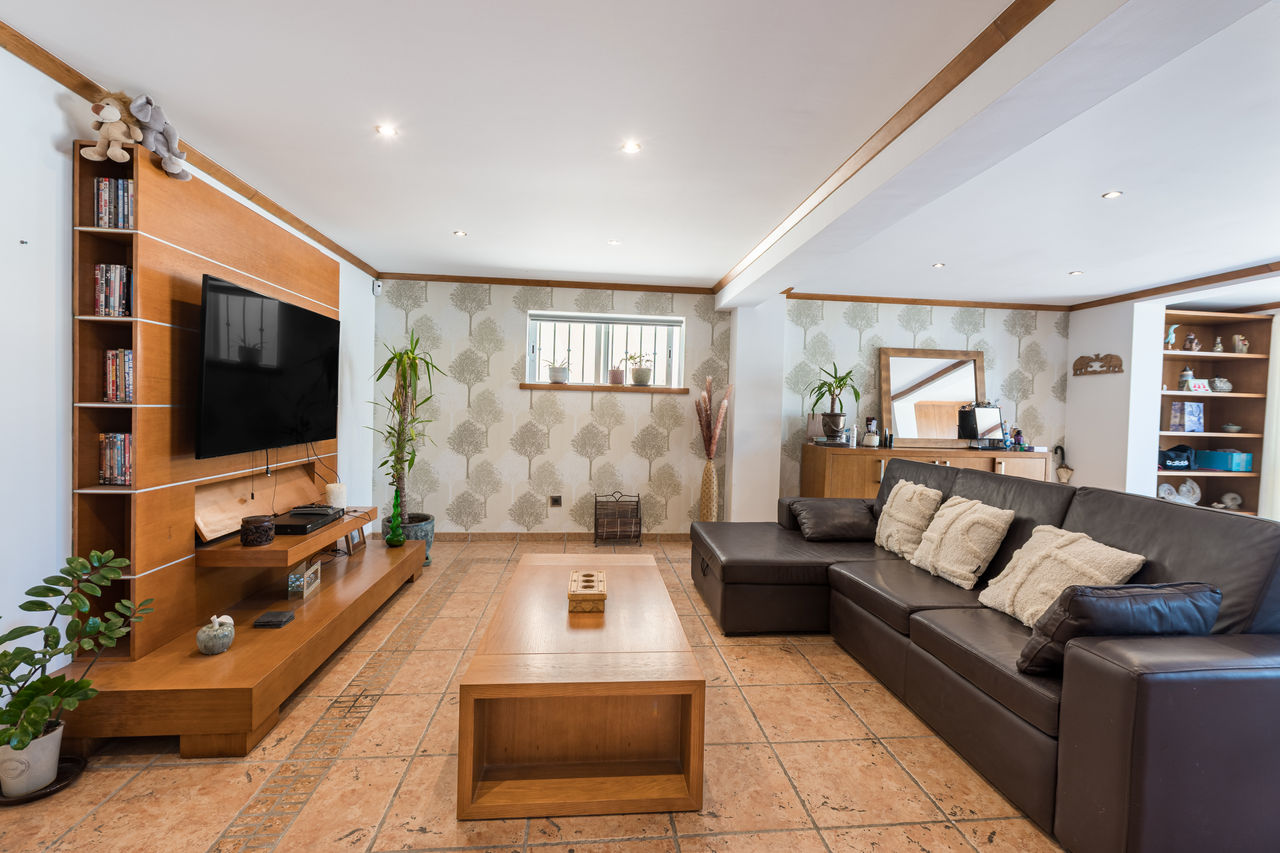
Clean, contemporary and refined — a completely different property needs a completely different visual approach.
There is a temptation in property photography to develop a recognisable formula and apply it everywhere.
Same angles. Same movements. Same editing. Same sequence.
Consistency is important, particularly technically, but properties aren't consistent.
A modern villa overlooking the coast shouldn't necessarily be photographed in exactly the same way as a traditional home in an Algarve town. A rural property in the Alentejo has a completely different relationship with its surroundings. A holiday rental needs to
communicate an experience as well as accommodation.
So before we start shooting, we're increasingly thinking about a more fundamental question:
What is actually special about this property?
Sometimes the answer is obvious.
Sometimes it takes walking around the property before we see it.
And occasionally it's something the owner points out that we might otherwise have missed.
Once we know the answer, it becomes much easier to decide what the photographs, drone footage and video need to accomplish.
We're still learning
Perhaps that's the biggest thing we've discovered from photographing properties across the Algarve and Southern Portugal.
There isn't one perfect formula.
Every property gives us a slightly different problem to solve. Different architecture, different light, different surroundings and, importantly, a different reason somebody might fall in love
with it.
Our equipment has changed. Our editing has changed. The way we shoot video has changed. And there are photographs we take today that we probably wouldn't have thought to take when we started.
That's a good thing.
Because ultimately, our job isn't simply to return from a property with a collection of attractive images.
It's to understand what makes that particular property worth seeing — and find the best way we can to show it.